
Fulani braids are a protective hairstyle defined by a center cornrow and face-framing braids, traditionally finished with beads or cowrie shells — named after the Fulani people of West Africa.
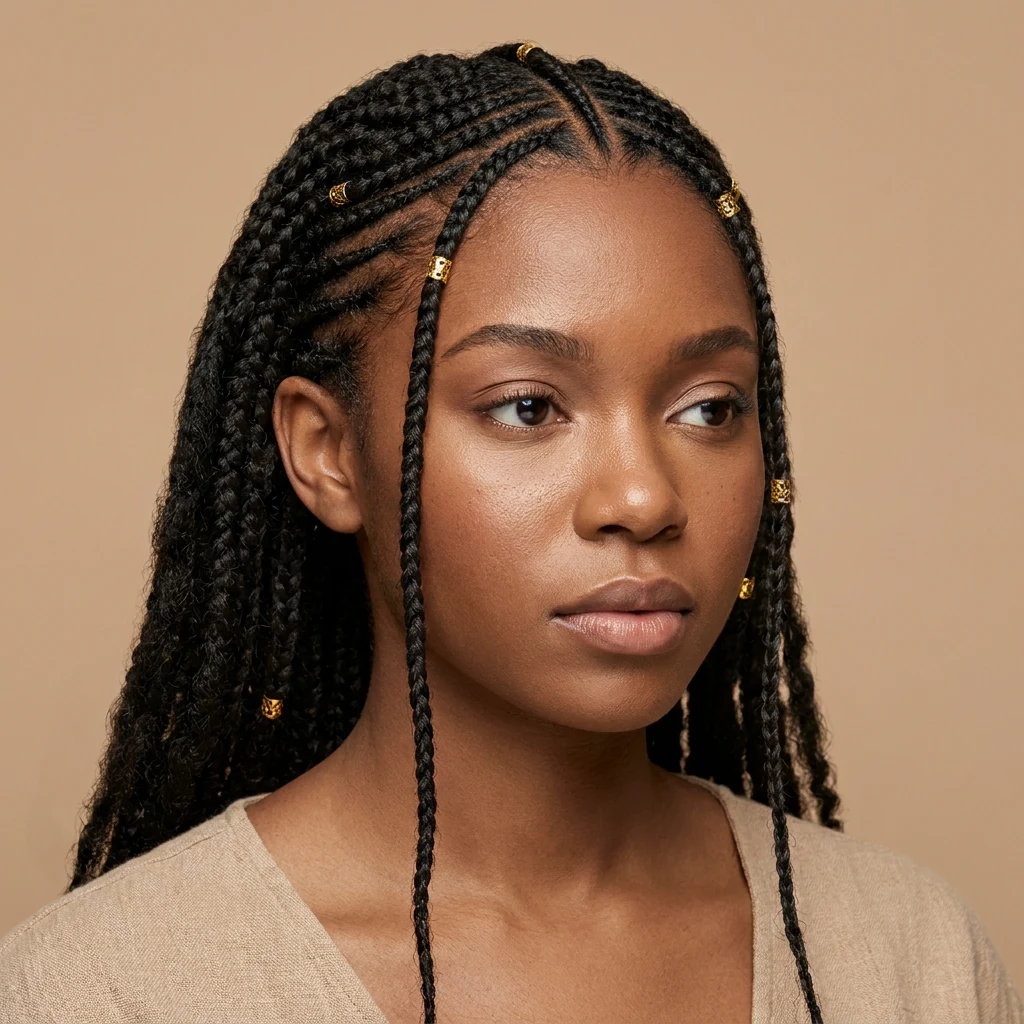
Fulani braids are a protective hairstyle defined by a center cornrow running from the front hairline to the back of the head, paired with thinner cornrows that frame the face on either side. The style is named after the Fulani people, a pastoral ethnic group spread across West Africa and the Sahel, and is traditionally finished with beads, cuffs, or cowrie shells.
Unlike box braids or knotless braids, which are built from individual square or triangular sections spread evenly across the scalp, Fulani braids are anchored by a distinct part pattern — usually one dominant center braid with smaller braids branching outward toward the temples and hairline. That structural pattern, more than any single material or length, is what makes a style recognizably "Fulani."
Ask five different braiders what makes a style Fulani and you'll get five slightly different answers, but most agree on the same core elements:
A single dominant braid running straight back from the front hairline.
Thinner braids on either side that follow the curve of the face.
Gold, wooden, or cowrie shell adornments worked into select braids.
Because "tribal braids" is often used as a catch-all term, Fulani braids get confused with similar-looking styles. Here's how they actually differ:
| Style | Part Pattern | Typical Finish |
|---|---|---|
| Fulani Braids | Center cornrow + face-framing braids | Beads, cuffs, cowrie shells |
| Box Braids | Even square sections, no center focus | Usually plain or curled ends |
| Straight-Back Cornrows | Parallel rows, no face-framing | Rarely beaded |
| Lemonade Braids | All braids swept to one side | Often colored or curly |
| Ghana Braids | Straight, uniform rows, no center focus | Usually minimal |
| Senegalese Twists | Two-strand rope twist, no cornrow base | Usually sleek, minimal |
| Tribal Braids (General) | Varied geometric patterns — broader category | Varies by design |
The pattern traces back to the Fulani people of the Sahel region, where braid placement and adornment historically carried real social meaning — signaling a woman's age, marital status, or family standing within the community. Braiding traditions in West Africa also served a more practical purpose beyond adornment: patterns and networks among women functioned as a way to communicate, including, historically, among enslaved women during the transatlantic slave trade — a dimension of the tradition's history that goes well beyond aesthetics. Modern interpretations have moved away from those original meanings, but the visual signature — center part, face-framing braids, beaded detail — has stayed remarkably consistent. Read the full cultural history →
No — Fulani braids can be done entirely on natural hair without any added hair, though most people add synthetic or human-hair extensions for length, fullness, and durability. If you're trying the style on your own hair for the first time, see our guide on doing Fulani braids with natural hair.
Independent informational website — not affiliated with any salon or brand. | Disclaimer | Privacy Policy | Contact