
Two of the most requested protective styles in the chair right now — and two very different scalp patterns underneath. Here's how the center-part cornrow crown of Fulani braids actually compares to the all-over grid of box braids, from West African roots to how each one wears down over the weeks.
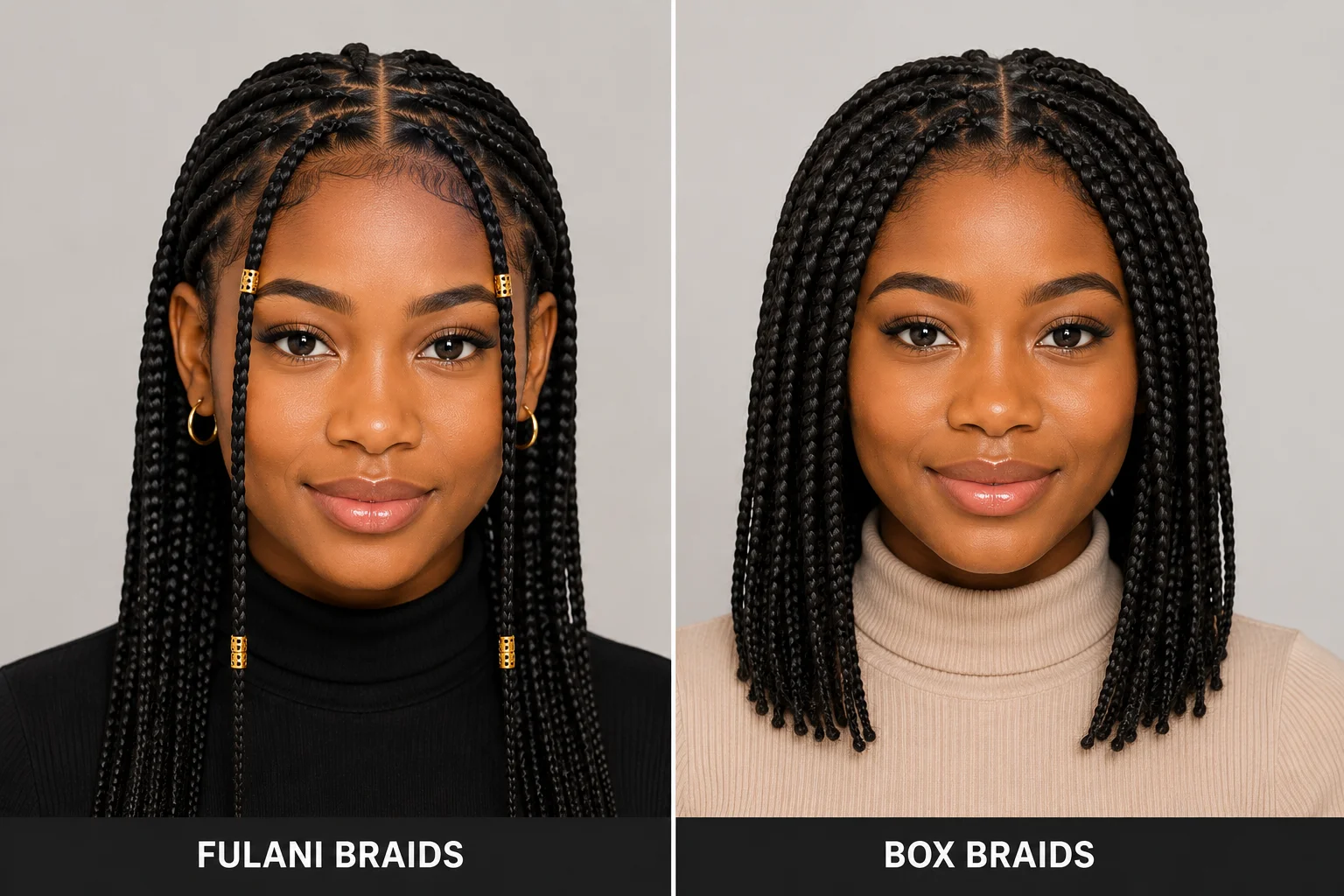
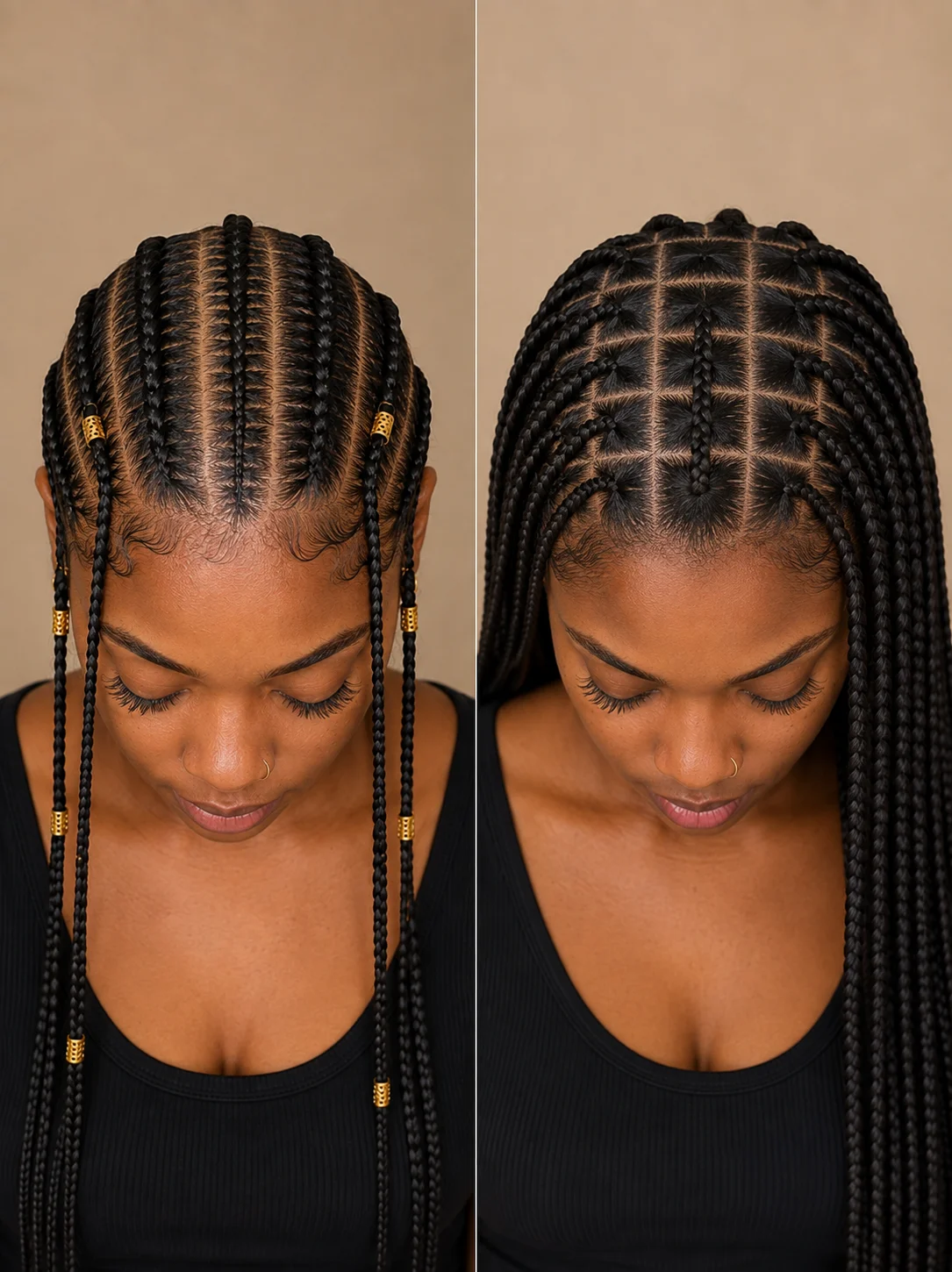
Fulani braids are built around a single cornrow that runs from the hairline to the nape, flanked by face-framing braids on either side, with the rest of the head filled in around that centerpiece. Box braids skip the centerpiece entirely — the whole scalp is divided into even square or rectangular sections, with no dominant part and no face-framing detail. That's the entire structural difference. Every other distinction between the two — how long each one lasts, what they cost, how they photograph, even where they come from historically — traces back to this one choice.
The styles also carry different histories. Fulani braids take their name and pattern from the Fulani (Fula) people of West Africa, where braiding traditionally carried real social meaning — patterns and adornments could signal things like community, age, or marital status, and beads or cowrie shells were part of that visual language rather than pure decoration. Box braids don't trace back to one specific group in the same way; the technique shows up across African and African-diasporic hair traditions for generations, valued more for protection and low daily upkeep than for carrying a specific symbolic pattern.
| Category | Fulani Braids | Box Braids |
|---|---|---|
| Pattern | Center cornrow + face-framing | Even square sections |
| Face-Framing | Yes — built into the design | No — neutral all over |
| Longevity | 6–10 weeks | 8–12 weeks |
| Day-to-Day Maintenance | Occasional edge/center-part touch-ups | Scalp moisture + hairline refresh |
| Install Time | 4–8 hours | 4–10 hours |
| Salon Cost | $150–$300+ | $150–$350+ |
| Adornments | Traditional (beads, cuffs, shells) | Optional |
| Beginner Friendly | Moderate | More forgiving |
| Updo Options | All (best at longer lengths) | All lengths |
| Cultural Origin | Fulani people, West Africa | Pan-African / diasporic traditions |
The face-framing braids in a Fulani install do double duty as a styling tool — they add soft lines on either side of the face, which tends to flatter rounder or squarer face shapes looking for a bit more definition near the cheekbones. Box braids don't frame the face the same way, so they read as more neutral regardless of face shape; the styling impact there comes down to parting size and length rather than a built-in frame.
For hair type, both styles work across the same range of natural textures, since the underlying technique — feeding extension hair into a natural-hair base — is identical. The practical difference shows up at the center part: because it's one continuous cornrow, Fulani braids need even tension along that row from front to back, so it's worth flagging a sensitive scalp or thinning edges to your stylist before you start. 4C and other tightly coiled textures actually hold a cornrow base especially well, thanks to the natural grip of the coil pattern.
The choice of extension hair texture affects how seamlessly the install blends with your natural hair, and the two styles have slightly different needs given how much of the scalp and root area is exposed.
Gives the sleekest, most polished finish — best suited to box braids, where there's no exposed center part to blend against natural texture.
Blends more seamlessly at the exposed Fulani center cornrow, since it matches natural hair texture more closely than a very silky strand.
Works well on the ends of either style if you want a curly-ends finish — see our guide on Fulani braids with curly ends.
Human hair holds up better to heat styling and looks more natural over time on both styles, at a higher cost than synthetic braiding hair.
Box braids typically last slightly longer than Fulani braids — 8 to 12 weeks compared to 6 to 10 weeks for most Fulani installs. The reason is the face-framing braids: these sections get more daily handling — being pushed back, tucked behind the ear, moved throughout the day — which causes them to frizz and loosen faster than the hanging sections of a box braid install, where every braid gets roughly equal treatment. The center cornrow of a Fulani install also shows new growth more visibly than the distributed sections of box braids, so the style can start looking grown-out sooner even while the braids themselves are still holding fine.
Maintenance habits track the same pattern: because the Fulani center part stays exposed, it benefits from a light oil or edge touch-up a bit more often to stay laid flat, while box braids mostly just need scalp moisturizing and an occasional hairline refresh.
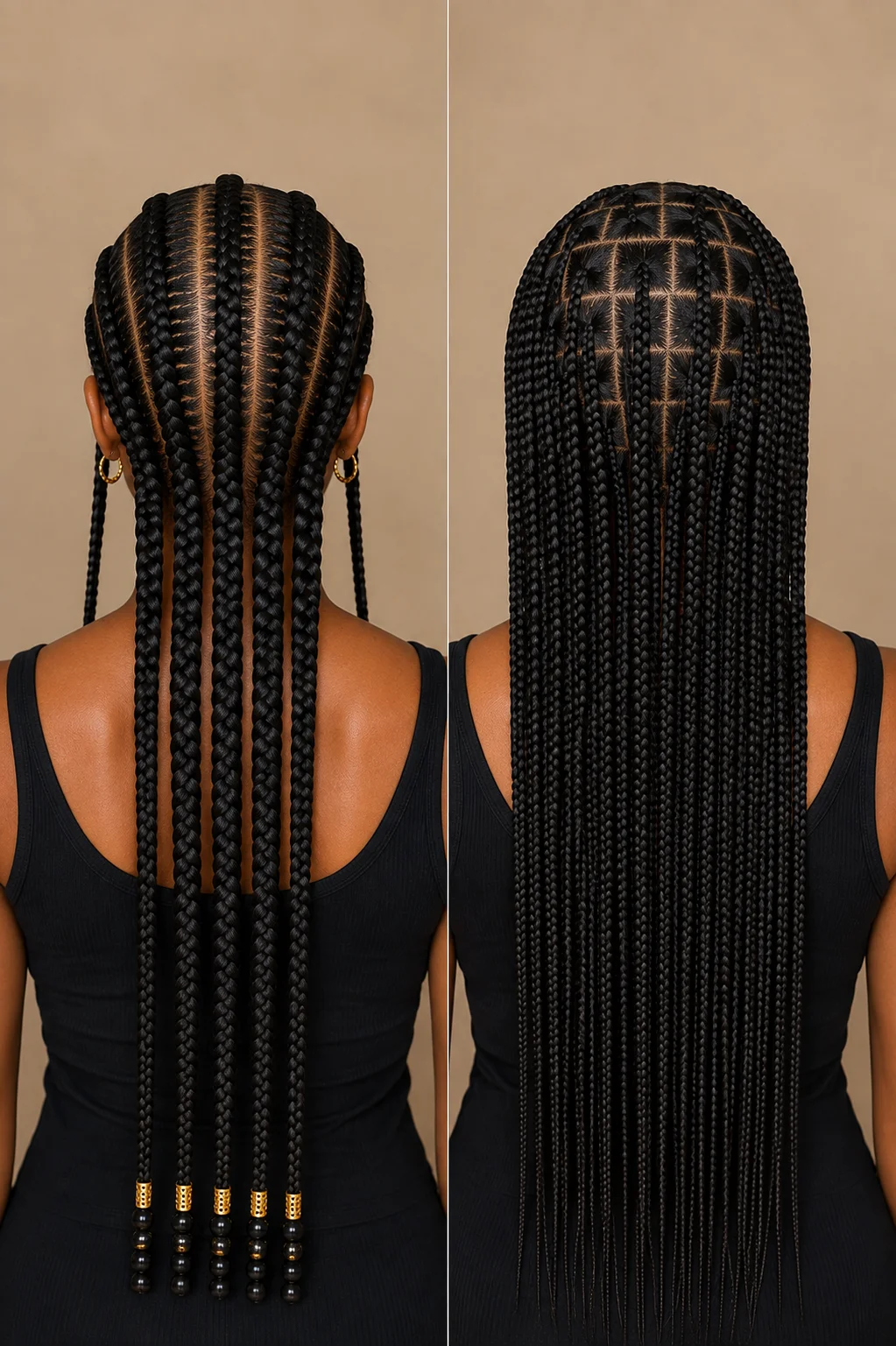
Would you rather your scalp pattern be part of the design, or disappear completely? A visible center part and face frame → Fulani braids. A clean, uniform grid with no single focal point → box braids. It's a styling preference, not a hair-health one — both are equally protective at the same tension and braid size.
Yes — a popular hybrid installs the Fulani center cornrow and face-framing braids up front, then fills the remaining sections with standard box-braid sectioning instead of the curved pattern of a full Fulani install. You get the signature Fulani face frame with the more uniform back distribution box braids are known for — a common request at braiding salons for anyone who can't decide between the two. Explore all Fulani pattern variations in our complete styles guide, and see how Fulani braids compare to cornrows and lemonade braids in our other comparison guides.
Whichever pattern you land on, both styles have popular variations worth knowing about before you book.
Independent informational website — not affiliated with any salon or brand. | Disclaimer | Privacy Policy | Contact