Both are cornrow-based, both hold up for weeks — but one is built to be perfectly symmetrical and the other is built to sweep in one direction. Here's how that single design choice plays out in face shape, styling versatility, and how the two are increasingly worn combined.

Fulani braids are built around a center part — a dominant cornrow running from the front hairline to the nape, with face-framing braids hanging symmetrically on both sides of the face. Lemonade braids skip the center part completely: every row is cornrowed and swept toward one side, exposing the scalp along the parted edge and pulling all the length and volume to the opposite shoulder.
Lemonade braids take their popular name from Beyoncé's 2016 Lemonade visual album, though the side-swept cornrow technique itself — sometimes called Ghana braids or banana braids — has been practiced for far longer. Fulani braids carry an older, more specific lineage, tracing to the braiding traditions of the Fulani (Fula) people of West Africa. One style is defined by a modern styling moment; the other by a much longer cultural history — which is part of why Fulani braids tend to come adorned with beads and cuffs as a core element, while lemonade braids rarely are.
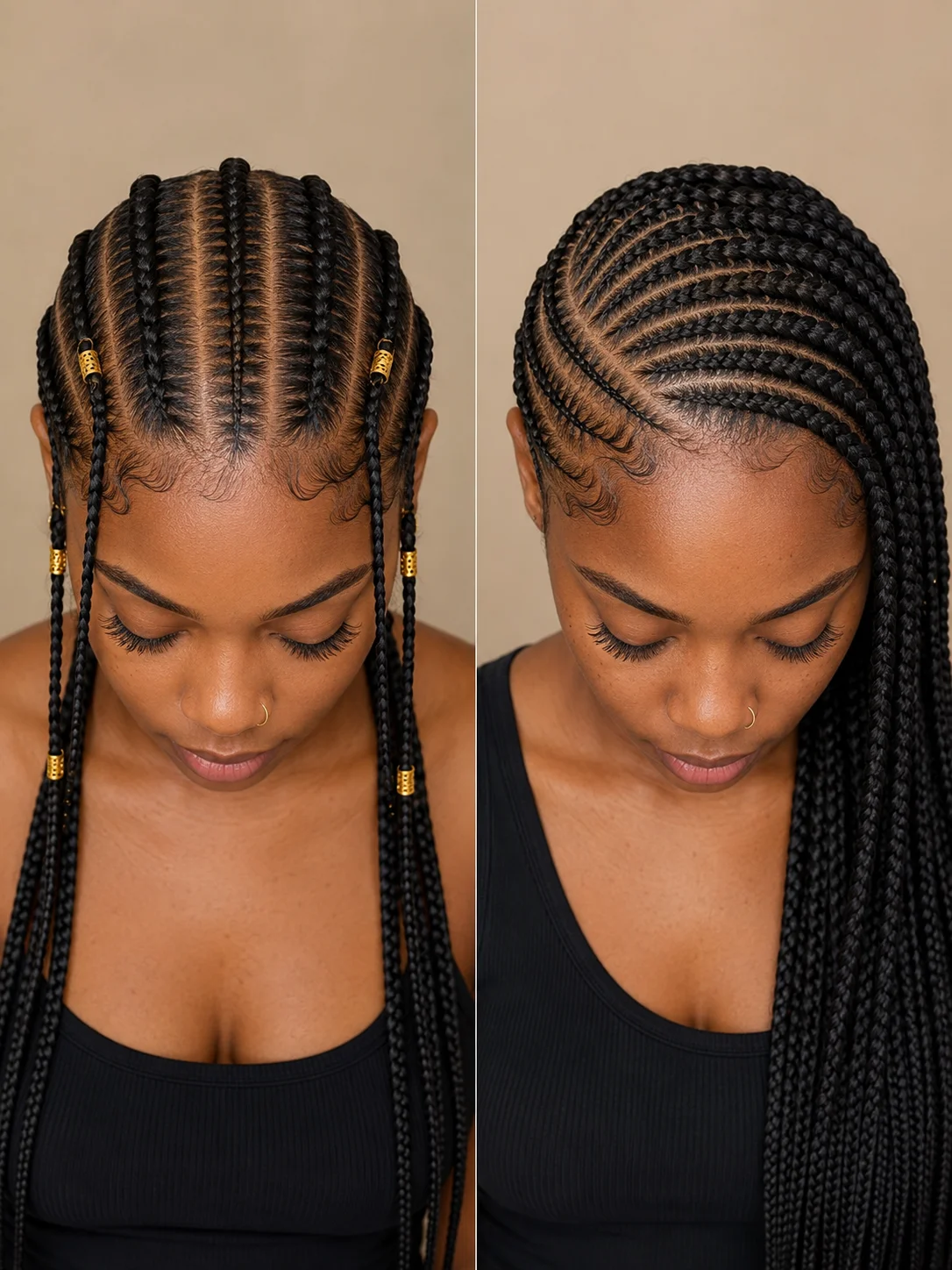
| Category | Fulani Braids | Lemonade Braids |
|---|---|---|
| Part Pattern | Center part, symmetrical | Side part, all swept one way |
| Silhouette | Balanced, face-framing | Asymmetric, directional |
| Longevity | 6–10 weeks | 6–10 weeks |
| Install Time | 4–8 hours | 3–6 hours |
| Salon Cost | $150–$300+ | $120–$280+ |
| Adornments | Traditional (beads, cuffs, shells) | Rarely used |
| Updo Options | Many — ponytail, bun, half-up | Limited — side sweep works best |
| Face Shape | All face shapes | Best on oval and heart shapes |
| Hairline Tension | Even across both sides | Concentrated on the parted edge |
Fulani braids suit a wider range of face shapes simply because the pattern is symmetrical — the face-framing braids on both sides create a balanced frame that works with oval, round, square, and heart-shaped faces without exaggerating any one feature. Those same braids add soft vertical lines that elongate rounder faces and soften angular ones.
Lemonade braids lean into asymmetry on purpose, and that tends to favor oval and heart-shaped faces especially — the side sweep elongates, and the exposed scalp on the parted side reads as a strong, deliberate line for anyone with more defined bone structure. On a very round face, though, that exposed-scalp side can visually widen the face rather than slim it, which is why round-faced clients often end up preferring the more centered Fulani pattern instead.
Fulani braids handle post-install restyling far better than lemonade braids. The centered pattern still looks intentional pulled into a ponytail, a bun, a half-up style, or flipped to one side, because there's no "wrong side" to hide. Lemonade braids are built to be worn in their swept direction — pulling them into a centered updo works against the entire point of the design, so most people wear them down or in a low side style for the full run of the install.
Yes, and it's become one of the most requested looks in braiding right now. A "lemonade Fulani" hybrid installs the Fulani center cornrow and face-framing sections up front — keeping the structured, symmetrical frame around the face — then transitions into a one-directional lemonade sweep toward the back or off to one side for the rest of the head. It's a way to get the best of both: the defined face-framing detail of a Fulani install with the swept, editorial finish of lemonade braids. Ask your stylist specifically for "Fulani in the front, lemonade in the back" to describe this hybrid clearly when booking.
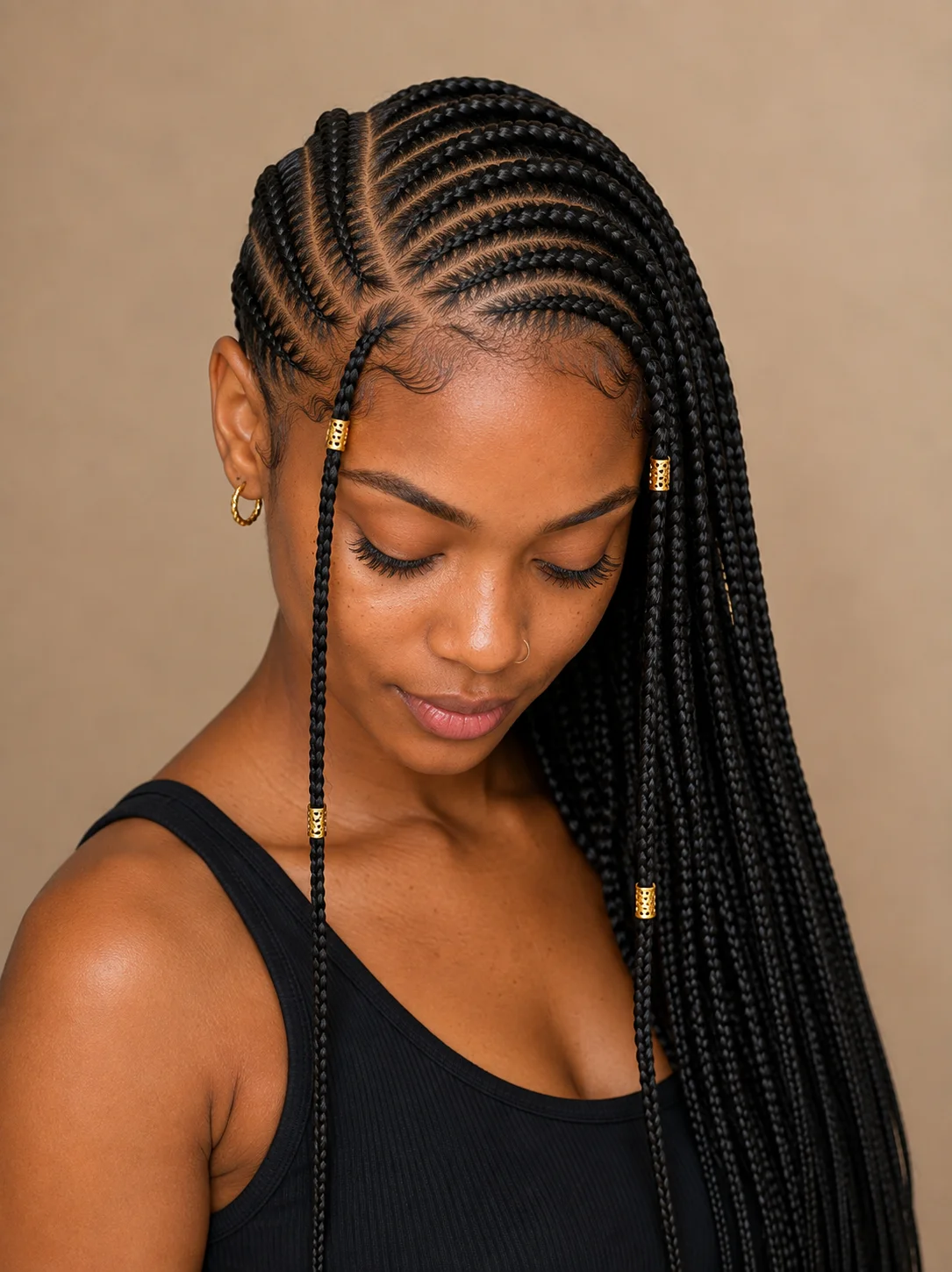
Because every row of a lemonade install anchors toward the same parted edge, that side can end up under more sustained tension than a Fulani install, where the pulling is distributed evenly across both sides. This matters most for anyone with a sensitive scalp or thinning edges. Asking for a knotless technique — where extension hair is fed in gradually instead of starting with a tight knot at the root — reduces that tension for either style, and it's worth requesting by name regardless of which pattern you choose.
Take a photo of your face straight-on and picture a line drawn right down the center. If your features feel balanced around that line, a Fulani part will frame you well. If your face reads as more interesting with the visual weight pulled to one side, a lemonade sweep will likely flatter you more — and if you like both answers, the hybrid version above lets you skip the choice entirely.
For more comparisons see our guides on Fulani braids vs box braids and Fulani braids vs cornrows, and explore all Fulani styles in our complete style guide.
Whichever pattern you land on, both styles have popular variations worth knowing about before you book.
Independent informational website — not affiliated with any salon or brand. | Disclaimer | Privacy Policy | Contact