
Everything you need to know about wearing Fulani braids on natural hair — from prep and hair type compatibility to how long the style lasts, how to maintain it, and how to avoid tension-related hair loss.

Fulani braids on natural hair are one of the most compatible protective style combinations available — the Fulani pattern works on virtually every natural hair type, from loose 3B curls to tight 4C coils, and can be worn with or without extension hair depending on the desired result. The center cornrow and face-framing braid structure that defines the Fulani look does not require a particular curl pattern to look polished, making it one of the most inclusive styles in the protective braid family.
The key difference between fulani braids on natural hair and other protective styles is how the natural texture interacts with the braid structure. On tighter curl patterns like 4C, the hair grips itself during braiding, creating firm, well-defined braids that hold their shape with minimal product. On looser textures, the braids require more product support and seal more carefully at the ends to prevent unraveling.
Whether you want fulani braids on natural hair with or without extensions, the prep work is the most important variable — properly moisturized, detangled hair produces significantly better braids than hair that is dry or product-heavy at install time.
The tightest curl pattern — holds fulani braids on natural hair extremely well without extra product. The coil grips itself during braiding, producing firm, long-lasting results. See our 4C specific guide.
Very similar to 4C in braid performance. Slightly more shrinkage means stretching before install helps achieve a cleaner center part and more even section sizes.
Works well with added product support. The looser curl pattern means braids may unravel faster at the ends — a small rubber band or braid gel at each tip extends longevity.
Part natural, part relaxed — can be braided into the Fulani pattern but the two textures create uneven tension. Extra care at the point where natural meets relaxed prevents breakage.
Wash with a clarifying shampoo to remove product buildup, then deep condition for at least 20–30 minutes. Fulani braids on natural hair installed on well-conditioned hair last longer and produce less frizz throughout the wear period.
Detangle in sections while hair is wet and coated with conditioner, working from ends to roots. Do not attempt to section or braid over tangles — it increases tension and causes breakage at the most vulnerable points of the natural hair shaft.
For tighter textures, stretch the hair before braiding using the banding method, African threading, or a low-heat blow dryer. Stretched natural hair sections more cleanly, produces a straighter center part, and braids more evenly from root to tip.
Work a lightweight braid gel or shea butter through each section before braiding. This smooths the cuticle without making the hair slippery, which helps the three braid strands grip each other during the braiding process.
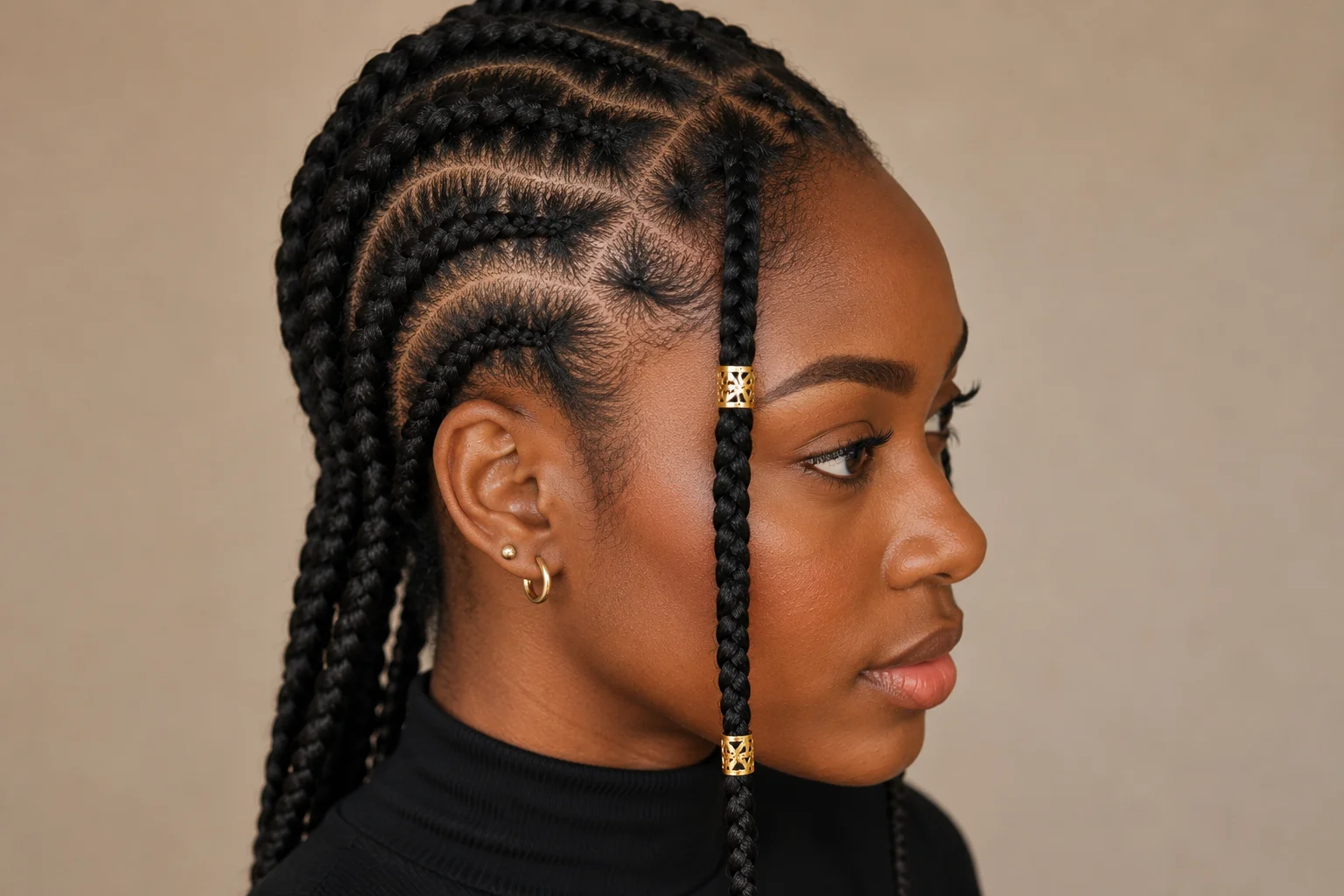
The longevity of fulani braids on natural hair depends primarily on whether extensions are used and how tightly the hair is braided. Without extension hair, fulani braids on natural hair typically last 2 to 4 weeks before the roots show significant new growth and the ends begin to unravel. With extension hair added, the same Fulani pattern can last 6 to 10 weeks — the weight and bulk of the extension hair keeps each braid tight and prevents the natural hair at the tip from slipping out.
Hair care routine also affects longevity significantly. Sleeping with a satin bonnet or on a satin pillowcase, keeping the scalp moisturized with a light oil, and avoiding heavy product application directly to the braids all extend how long fulani braids on natural hair look fresh. See our full maintenance guide for a complete care routine.
Yes — fulani braids on natural hair are a genuinely protective style when installed correctly. The style tucks away the ends of the natural hair, which are the oldest and most fragile part of the hair shaft, and eliminates the daily manipulation of combing, brushing, and styling that causes the most mechanical breakage. For people trying to retain length, fulani braids on natural hair installed at moderate tension and removed at the 6–8 week mark represent one of the most effective protective styling approaches available. The most common mistake is leaving the style in too long — beyond 8–10 weeks, the shed hair that accumulates inside the braids begins to cause matting and increases breakage risk significantly during takedown.
Traction alopecia is gradual hair loss caused by sustained pulling at the hair root — and it's the single most important risk to understand before getting any tightly-braided protective style, including Fulani braids on natural hair. It develops slowly over repeated tight installs rather than from any single style, which is exactly why it's easy to overlook until real damage has occurred.
— Persistent pain or tenderness at the roots beyond the first day or two after install (mild tightness on day one is normal; ongoing pain is not)
— Small bumps or pimple-like irritation along the hairline where tension is concentrated
— Visible thinning or a receding pattern specifically at the temples or hairline, rather than evenly across the scalp
— Hair breaking off short near the root instead of growing out normally, especially noticeable when the style is taken down
The good news: traction alopecia caught early is usually reversible — the hair follicle isn't permanently damaged unless the tension continues over a long period. If you notice any of the signs above, the right response is to take the style down, give your scalp a genuine rest period of several weeks before your next install, and ask your next braider specifically for looser tension, especially at the hairline and center part. Repeatedly ignoring these signs and re-installing tight styles back to back is what turns a reversible warning into permanent thinning.
Independent informational website — not affiliated with any salon or brand. | Disclaimer | Privacy Policy | Contact