
How to thread, place, and arrange gold cuffs, cowrie shells, and wooden beads on Fulani braids — the complete beading guide from a licensed braiding specialist.
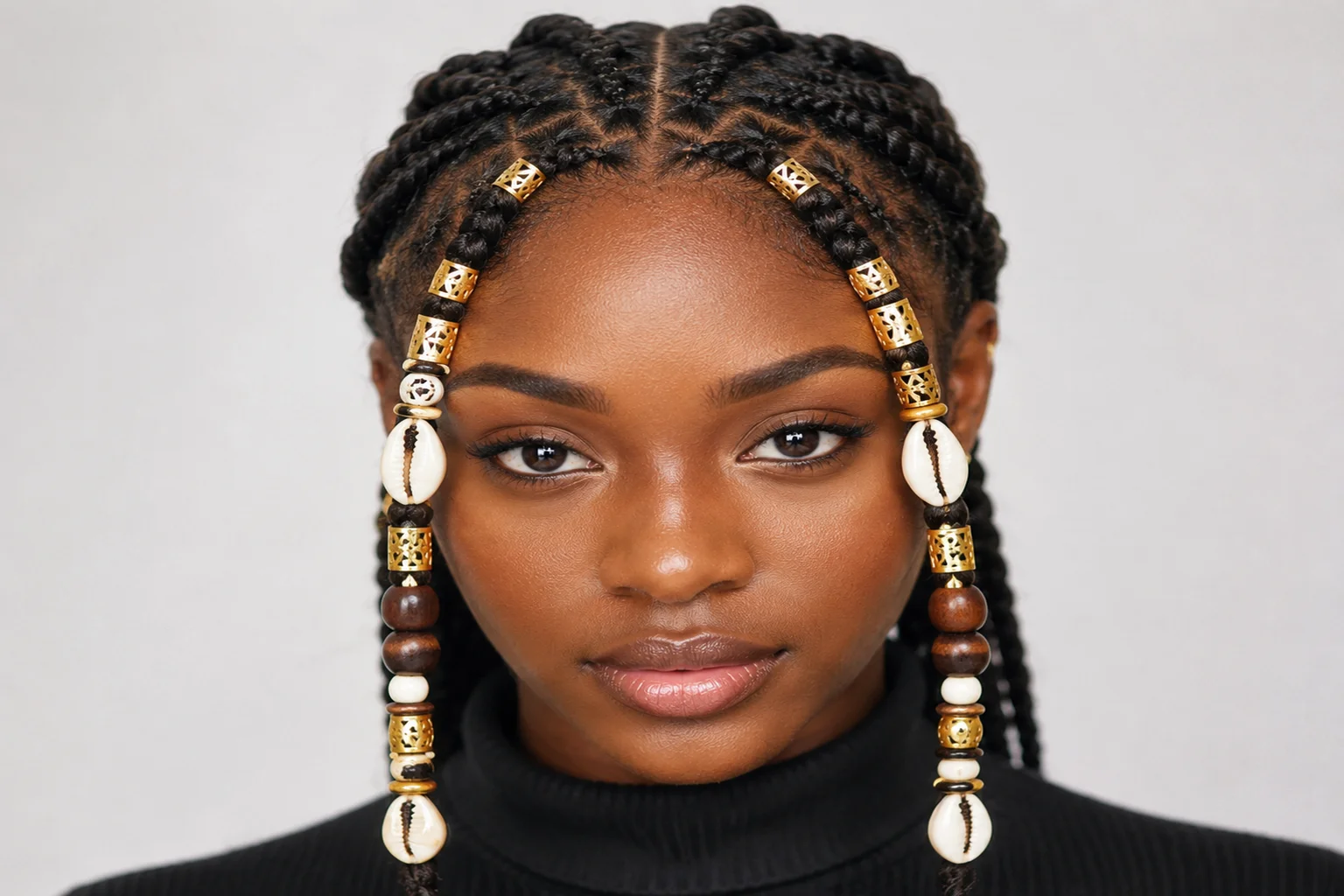
Learning how to do Fulani braids with beads starts with understanding that beads are not just decorative — they are one of the defining features that distinguish the style from other protective braid patterns. Traditionally, the Fulani people of West Africa used beads and adornments to signal social status, age, and family affiliation, with specific bead types carrying specific meanings within the community. Modern Fulani braids with beads retain the visual signature of the traditional style while adapting the materials for contemporary wear.
The three core bead types used when you how to do Fulani braids with beads are gold cuffs, cowrie shells, and wooden beads — each contributes a different visual texture and weight to the finished braid. Most Fulani braid installs mix all three rather than using just one type, creating a layered, rich look that references the traditional pattern while allowing for personal customization.
Metallic barrel or tube-shaped cuffs that slide over the braid and crimp in place. The most used adornment in modern Fulani braids.
The most culturally significant adornment — traditionally linked to femininity and prosperity in West African culture. Threaded through a hole drilled in the back of the shell.
Round or barrel-shaped beads in natural brown or cream tones. Add warmth and weight to the braid, helping it hang with a more defined swing.
Larger threaded beads with wider holes — easier to add mid-braid and create a bolder visual statement than cuffs.
Lightweight and available in every color — useful for color-coordinated looks or for adding beads to colored Fulani braids.
Most traditional and modern looks mix bead types on each braid — alternating cuffs, shells, and wooden beads for visual rhythm.

All beads must be threaded onto the braid before the ends are heat-sealed. A sealed synthetic braid tip is thicker and stiffer than an unsealed one — threading beads after sealing is very difficult and risks damaging the braid tip.
For cowrie shells and wooden beads with small holes, insert a latch hook or beading needle through the bead hole, catch the braid tip in the hook, and pull the braid through. This technique works for any bead where the hole is too small to thread by hand.
Gold cuffs have an open end that slides directly over the braid. Position the cuff at your chosen point on the braid, then squeeze gently with your fingers or flat-nose pliers to crimp it in place. Do not over-crimp — just enough to prevent the cuff from sliding.
For beads with larger holes that won't stay in place on their own, place a small clear rubber band above and below the bead to hold its position on the braid. This is especially useful for wooden beads near the ends of longer braids.
Once all beads are in position, dip the remaining braid length below the last bead briefly in hot water to seal the synthetic hair tip. The bead stack stays in place above the sealed section.
Placement matters as much as bead selection when learning how to do Fulani braids with beads. The traditional arrangement concentrates adornments on the face-framing braids where they are most visible during everyday wear, with a secondary cluster at the end of the center cornrow. where they are most visible during everyday wear, with a secondary cluster at the end of the center cornrow.
There is no fixed rule on how to do Fulani braids with beads in terms of quantity, but the traditional Fulani aesthetic favors concentrated adornment on a small number of braids rather than sparse decoration spread across all of them. A typical modern install places 4–7 beads on each face-framing braid, 2–3 on the center cornrow tail, and leaves the remaining box braids plain or with a single cuff each.
Overloading all braids with beads increases weight significantly and can cause tension on the scalp over time — concentrating adornment on the face-framing sections gives the visual impact of a heavily beaded style without the weight burden of beading every braid. See our full guide on Fulani braids with beads styles for more inspiration and variation ideas, and our maintenance guide for tips on keeping beaded Fulani braids looking fresh.
Independent informational website — not affiliated with any salon or brand. | Disclaimer | Privacy Policy | Contact