A polished updo that keeps the Fulani center-cornrow pattern on full display — the Fulani braids bun works for weddings, proms, and everyday elegance alike.
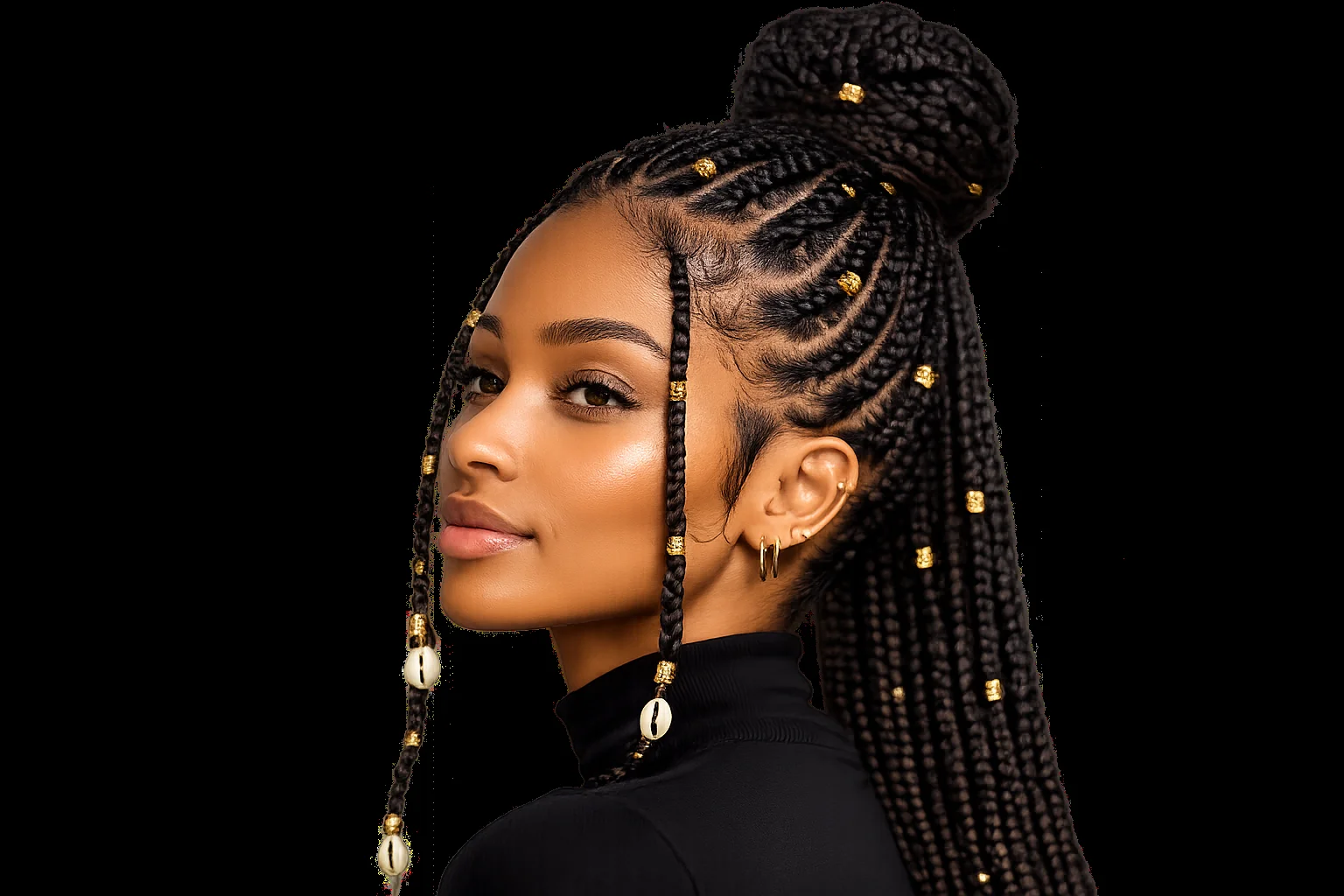
A Fulani braids bun takes the center-cornrow and face-framing pattern of classic Fulani braids and gathers all the length into a coiled or twisted bun — either high at the crown or low at the nape. Unlike a ponytail, which lets the length hang loose, the bun tucks everything up into a compact shape, creating a cleaner and more formal silhouette.
What makes the Fulani braids bun distinctive is that the front cornrow pattern stays fully visible. The scalp braids running toward the crown become the focal point of the look — the bun itself is the punctuation, not the whole sentence. This is why the style reads as elevated and intentional rather than simply "hair up" — the pattern does the visual work while the bun adds polish and structure.
The face-framing braids are almost always left loose, hanging on either side of the face, to preserve the defining detail of the Fulani pattern. Leaving them down also softens the look, preventing the bun from reading as too severe for everyday wear.
The most dramatic and formal version of the Fulani braids bun — gathering all the length to the crown and coiling it into a tight bun creates maximum height and elongates the neck. This variation is best for weddings, proms, or any occasion where you want the hairstyle to be a clear focal point. The scalp cornrow pattern leading up to the crown is fully visible from all angles, which is exactly what makes this variation so striking.
A more relaxed Fulani braids bun gathered at the nape rather than the crown. Easier to maintain throughout a long day, less tension on the scalp, and appropriate for workplaces or occasions where a very high bun might feel too statement-forward. The Fulani pattern is still clearly visible from the front, while the back sits neatly contained.
A looser, less-structured version where the braids are coiled into a bun but allowed to be slightly undone — a few braids escaping, some curly ends left loose, a more relaxed overall shape. This works well with boho Fulani braids or curly ends where the texture adds to the effect rather than looking unfinished.
All braids gathered tightly at the crown, edges laid smooth, face-framing braids left loose at the front. Maximum formality.
Relaxed gathering at the nape — less tension, more casual, still shows the full Fulani front pattern.
Slightly undone with loose ends or curls escaping — works best with curly-end or boho Fulani installs.
Only the top section gathered into a bun, with the remaining braids left loose — see our Half-Up Half-Down guide.

The Fulani braids bun is one of the easiest updo styles to achieve at home — it requires no tools beyond bobby pins and a fabric elastic, and takes under ten minutes once you know the steps.
Work edge control into the hairline and baby hairs before gathering anything — smoothing edges after the bun is already pinned is much harder and risks disturbing the shape.
Separate the two or three face-framing braids on each side and clip them out of the way — these stay down to preserve the Fulani pattern detail.
Gather all remaining braids to your chosen point — high crown or low nape — and secure loosely with a fabric elastic as a temporary hold before pinning.
Twist or coil the gathered braids around the elastic base and secure with bobby pins, tucking the ends under. Use as many pins as needed — Fulani braids buns hold better with more pins rather than relying on tension.
Unclip the face-framing braids and let them fall naturally. Apply a light setting spray over the bun to hold flyaways and maintain the shape throughout the day.
The Fulani braids bun is one of the most occasion-versatile updo options within the Fulani style family. A sleek high bun is polished enough for weddings and formal events, while a low or boho bun works equally well for school, work, or casual outings. Unlike the ponytail, which reads as athletic in lower versions, the bun almost always signals polish regardless of how high or low it sits — making it the more formally flexible of the two updo options.
For weddings specifically, the high Fulani braids bun paired with gold cuffs or cowrie shells threaded into the face-framing braids is a particularly striking choice — the adornments catch the light and the overall silhouette reads as bridal without requiring any additional accessories. For school or everyday wear, a simple low bun with no added adornments keeps things neat and professional without looking overdressed.
Independent informational website — not affiliated with any salon or brand. | Disclaimer | Privacy Policy | Contact