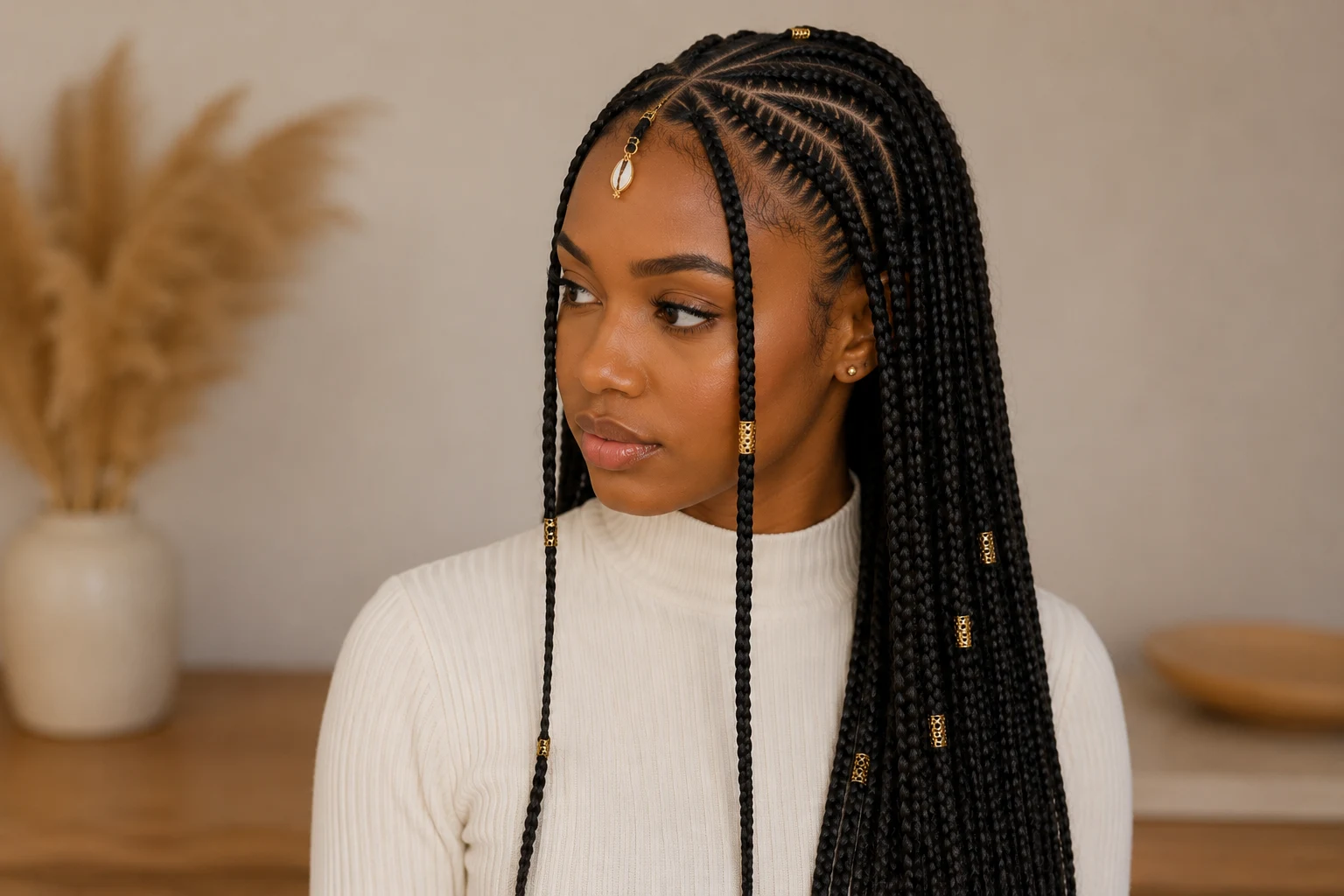
What Makes Them Knotless?
Traditional Fulani braids start each braid with a small knot at the root where extension hair is attached to your natural hair. That knot creates a raised bump at the base and puts immediate tension on the root from the first stitch. Knotless braids solve this by starting the braid with your own natural hair first, then feeding extension hair in gradually — so there's no knot, no bump, and significantly less tension at the scalp.
The result is a flatter, smoother base that looks more natural at the hairline, and feels noticeably more comfortable in the first few days after install when tension is typically at its highest.
Knotless vs. Regular Fulani Braids — Comparison
| Feature | Knotless | Regular (Knotted) |
|---|
| Root Base | Flat, smooth, no bump | Small knot visible at root |
| Scalp Tension | Low — gradual feed-in | Higher — immediate knot tension |
| Hairline Look | More natural, seamless | Defined bead-like start |
| Lifespan | 4–6 weeks | 6–8 weeks |
| Cost | Higher by $30–80 typically | Standard pricing |
| Install Time | Longer (more technique) | Faster |
Who Should Choose Knotless?
Knotless Fulani braids are a better choice if you have a sensitive scalp, fine or fragile edges, or have experienced tension-related hairline thinning with previous braid installs. They're also a good option if you want a cleaner hairline appearance — the feed-in technique creates a more gradual, natural-looking start to each braid rather than a visible bump.
Sensitive Scalp
Less tension at the root from day one, so the first few days are more comfortable.
Fine or Fragile Edges
Reduced stress on the hairline means lower risk of traction-related edge loss over time.
Natural Hairline Look
The gradual feed-in creates a seamless, natural-looking start to each braid.
Lighter Feel
No knot weight at the root, so the braids feel noticeably lighter as they move.
Tip: Not all braiders are equally skilled at the knotless technique — ask to see examples of their knotless work specifically before booking, since the quality varies much more than with traditional knotted braids.
Popular Knotless Fulani Combos
Knotless is rarely the whole story — it's often combined with another technique or style choice for a specific practical or aesthetic reason.
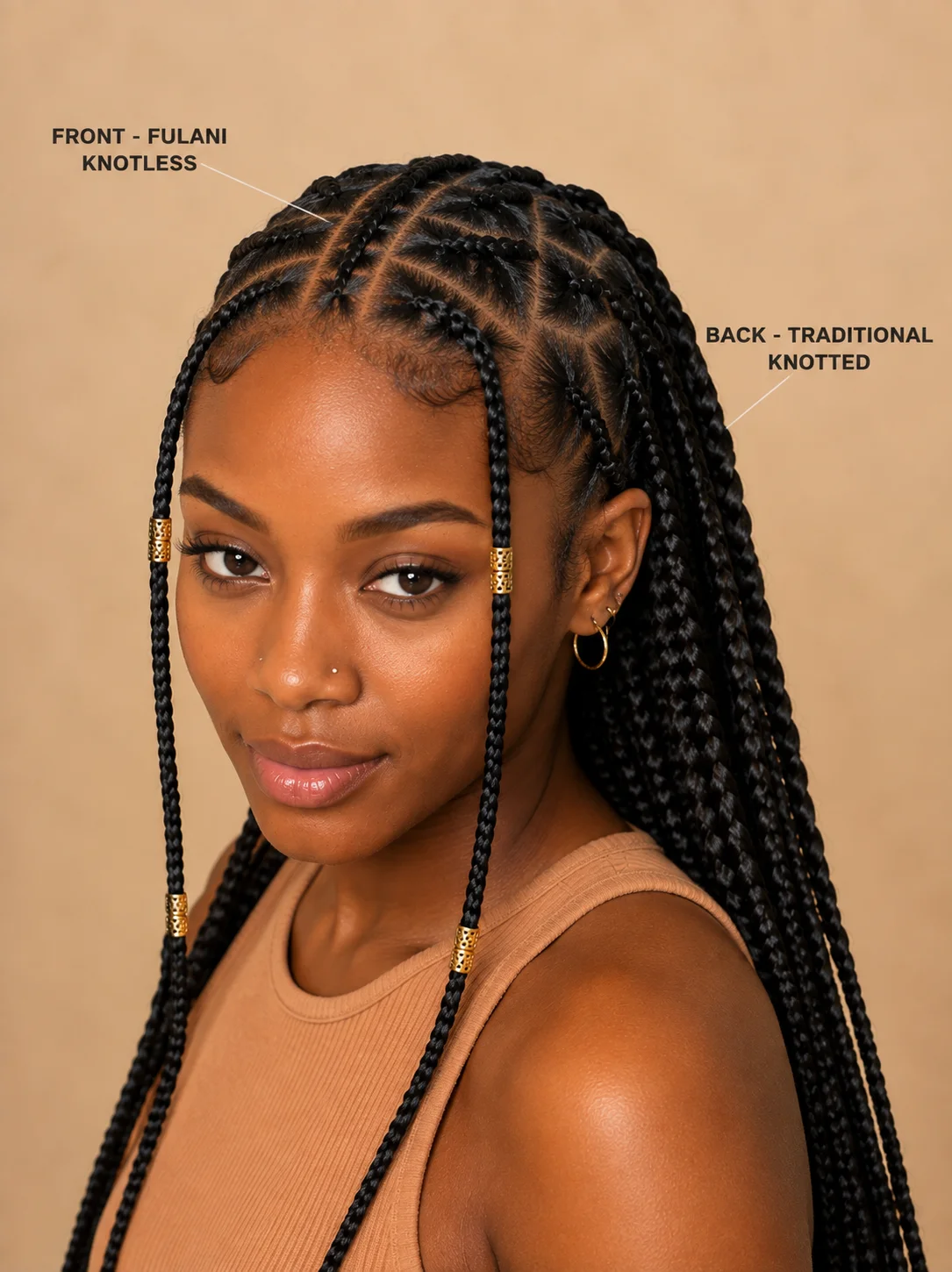
- Half Fulani, half knotless: A genuinely popular hybrid where the front face-framing sections use the knotless technique for a softer hairline, while the back uses regular knotted braids to save on install time and cost — the tension difference matters most where it's visible, at the front.
- Knotless + boho curls: Pairing the flatter, gentler knotless base with curly ends is a frequently requested combination, since both choices prioritize comfort and a softer overall look.
- Knotless + beads: Because knotless braids sit flatter at the root, beads placed on face-framing sections tend to sit more evenly without the knot creating an uneven base to work around.
Caring for Knotless Fulani Braids
Knotless braids need a slightly different care rhythm than knotted ones, mainly because the lower root tension means the pattern loosens a bit faster.
- Expect visible growth sooner: Because there's less tension anchoring the braid at the root, new growth becomes visible slightly earlier than with knotted braids — this is normal, not a sign of a bad install.
- Moisturize regularly: A light scalp oil or leave-in spray every 2–3 days keeps the exposed root area from drying out, since knotless bases expose slightly more scalp than a knotted start.
- Consider a mid-point touch-up: If you want to stretch wear past the typical 4–6 weeks, a root touch-up around week 3–4 on the most-handled sections (usually the face-framing braids) can extend the style's life.
- Sleep protection matters more: The flatter, lower-tension base is slightly more prone to frizzing from friction, so a satin scarf or bonnet at night helps knotless braids hold their shape longer than they would going in unprotected.
Frequently Asked Questions
What is the difference between knotless and regular Fulani braids? +
Regular Fulani braids start with a knot at the root where the extension hair is attached, creating a small bump. Knotless Fulani braids feed the extension hair in gradually after starting with the natural hair, resulting in a flatter base with less tension.
Are knotless Fulani braids better for your hair? +
Generally yes — the reduced tension at the root puts less stress on the hairline and scalp, making knotless braids a better option for people with sensitive scalps or fine edges.
Do knotless Fulani braids cost more? +
Usually yes, by $30 to $80 on average, since the technique takes more time than the traditional knotted method.
Do knotless Fulani braids last as long? +
Knotless braids typically last slightly less time — around 4 to 6 weeks compared to 6 to 8 weeks — because the root area has less tension keeping the braid anchored.
What is half Fulani half knotless? +
It's a hybrid style where part of the head — often the front face-framing sections — uses the knotless technique for a softer hairline, while the rest uses regular knotted braids for faster installation and lower cost.
How do you take care of knotless Fulani braids? +
Expect visible new growth slightly sooner than knotted braids since there's less root tension holding the pattern tight. Moisturize the scalp every 2–3 days, sleep with a satin scarf, and plan a touch-up around week 3–4 if you want to extend wear past the typical 4–6 week lifespan.